
How to Search Heard County Court Records
Heard County does not publish one county-run search screen for all court cases. The strongest online starting point for Superior Court records is the Georgia Courts E-Access Court Records page, which routes Heard Superior records through the provider path used by the state. The state page warns that provider access requires an account. For Heard County, that means online access should be treated as a starting point, not as the only official channel.
Use the court type to pick the next step. Superior Court records, including many civil cases, felonies, divorce files, and land-title matters, route through the Clerk of Superior Court. Probate Court keeps probate, marriage, vital-record, weapons-license, and county traffic citation functions. Magistrate Court keeps small civil, dispossessory, warrant, bond, and preliminary-hearing matters. Juvenile Court files are restricted and should not be searched like ordinary public case files.
- Identify the court from the case notice, citation, party paperwork, or record type before searching.
- For Superior Court matters, start with Georgia Courts E-Access and the Heard Superior provider route.
- If the online provider does not show the file, contact the Clerk of Superior Court with the party name, case number if known, approximate year, and record type.
- For Probate Court or Magistrate Court matters, contact that court directly because those offices maintain separate local functions.
- Use the Heard County open-records form when the record is not online or the correct destination office is unclear.
The PeachCourt court document platform is one of the provider paths tied to Georgia court records. Its public-facing service is built around account access, court documents, and e-filing workflows. A public user may not see a full Heard County case file without logging in, paying a provider charge, or asking the clerk for copies.
The manifest image for PeachCourt shows the court document provider route that appears in Georgia's statewide access map.

That provider image matters because Heard County court records are not all exposed through a county-owned public case index.
Heard County Court Records Search Fields
The research did not locate a public, unauthenticated sample Heard Superior case result. The Georgia Courts E-Access page does provide the access model: users select a county or court provider link, follow the provider route, and use an account-based search system. That is enough to describe the official search fields without promising public fields that were not visible during inspection.
| Field Label | Type | Required | Notes / Format |
|---|---|---|---|
| County or court provider link | Link list | No | The state page redirects users to providers such as PeachCourt or re:SearchGA. |
| Account access | Login or registration | Yes for search use | Georgia Courts states the provider website requires an account to search court records. |
| Heard Superior | Provider link | No | Heard Superior appears as a PeachCourt route in the state access structure. |
| Register | Account workflow | Yes for provider services | PeachCourt presents registration and login for court document and e-filing features. |
| Court documents / eFiling | Service category | No | Provider services include civil and criminal court document workflows across Georgia. |
The re:SearchGA platform is another statewide court-records repository for participating Georgia courts. It is useful context for account-based access, but the research identified PeachCourt as the official Heard Superior path from Georgia Courts E-Access.
The manifest image for re:SearchGA documents the broader statewide case-record provider environment.
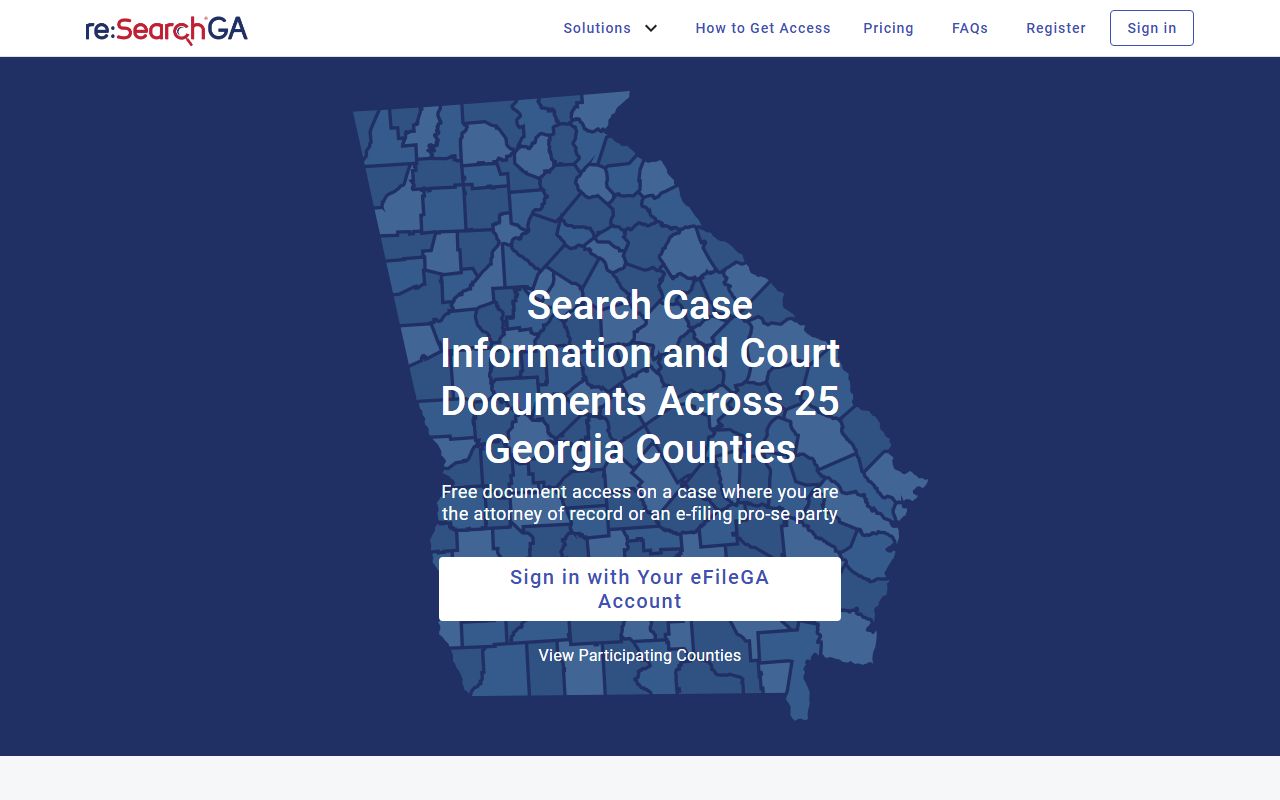
Because provider participation varies by court, Heard County users should still verify Superior Court files with the local clerk when a provider search is incomplete.
Types of Heard County Court Records
Heard County court records are divided by court function. Superior Court is the broad trial court for felonies, divorce, equity, title-to-land issues, major civil matters, and lower-court review. Probate Court handles wills, estates, guardianships, conservatorships, marriage licenses, vital records, weapons carry licensing, fireworks permits, and Heard County traffic citations. Magistrate Court handles small civil claims, dispossessory cases, warrants, bond matters, preliminary hearings, and other local magistrate work.
Records from one court should not be assumed to exist in another office. A divorce decree belongs with the Clerk of Superior Court. A marriage license belongs with Probate Court. A county traffic citation may route through Probate Court and EZCourtPay, while a city ticket may require a municipal court. Juvenile Court handles delinquency, truancy or unruly matters, and dependency cases, but public access is limited.
- Civil Superior Court records may include complaints, answers, motions, orders, judgments, notices, and appeal entries.
- Criminal Superior Court records may include accusations, indictments, arraignment entries, bond orders, pleas, sentencing orders, and probation terms.
- Family and divorce records may include complaints, service, parenting plans, support worksheets, final decrees, and later modification filings.
- Probate records may include wills, petitions, inventories, letters, orders, accountings, guardianship reports, and estate notices.
- Magistrate records may include small claims, dispossessory filings, preliminary hearings, warrant applications, and bond-related entries.
- Traffic court records may include citation number, issuing agency, charge, court date, fine, plea status, disposition, and payment status.
What Heard County Court Records Show
A Heard County court record is usually a file and a docket. The file holds papers filed by parties, lawyers, agencies, or the court. The docket is the chronological list of filings and events. A full case record can show who filed the case, which court handled it, when hearings occurred, what orders were entered, and how the case ended. Online provider access may show less than the clerk's complete file.
| Field | What It Shows |
|---|---|
| Case number | The court's tracking number; use the exact number from notices, citations, docket printouts, or clerk receipts when possible. |
| Court name | Superior Court, Probate Court, Magistrate Court, Juvenile Court, or a municipal court if a city matter is involved. |
| Filing date | The date the complaint, petition, accusation, indictment, citation, or application was filed. |
| Party names | Plaintiff and defendant, state and defendant, petitioner and respondent, applicant, decedent, ward, or other case-specific roles. |
| Docket entries | Filings, notices, hearings, orders, continuances, pleas, judgments, sentencing, payment entries, and case closure. |
| Financial fields | Filing fees, fines, costs, restitution, bond, certified-copy charges, and payment status where those fields exist. |
| Redactions | Restricted data such as Social Security numbers, financial account numbers, minor names, medical details, sealed filings, and protected addresses. |
Public Access for Heard County Court Records
Georgia law favors access to public records, but court records are still shaped by court rules, privacy statutes, and case-specific orders. The Georgia Open Records Act, O.C.G.A. 50-18-70 et seq., gives the general presumption of public access to government records unless an exemption applies. O.C.G.A. 50-18-71 covers response timing and lawful search or copy charges. O.C.G.A. 50-18-72 lists exemptions that may require withholding or redaction.
Superior Court files also sit under court access rules. Uniform Superior Court Rule 21 says court records are public unless access is limited by law or the rule's procedure. In practical terms, Heard County requesters should ask the office that keeps the record. A certified copy should be requested from the appropriate clerk rather than from a general request form, because certification requires the court seal and clerk process.
Note: Certified court copies should come from the court clerk that keeps the original file, not from a provider screenshot.
The manifest image for the Georgia open-government FAQ connects Heard County record access to state public-record principles.
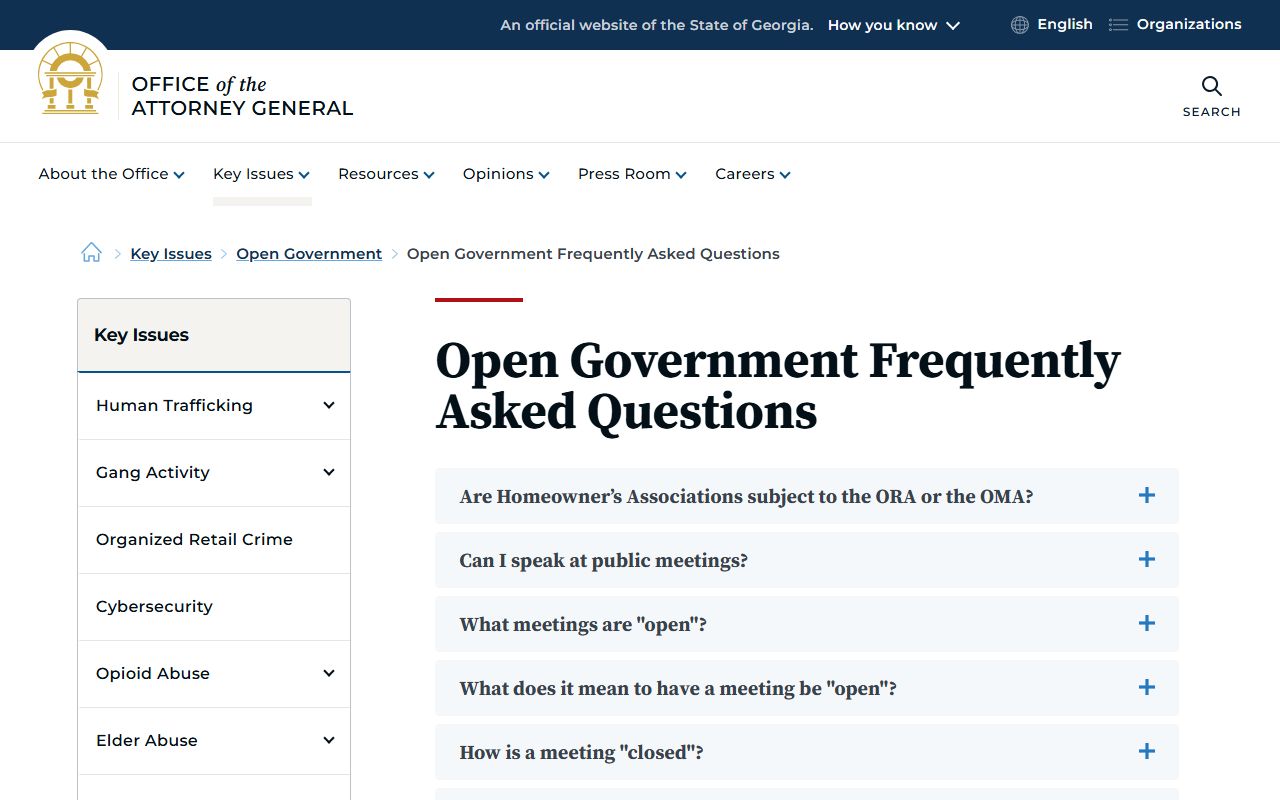
The state law source helps explain why access may be available even when a record is not published in an online search portal.
Restricted Heard County Court Records
Not every Heard County court record is public in full. Juvenile Court records involving delinquency, truancy or unruly matters, and dependency cases are not ordinary public dockets. Access normally depends on party status, parent or guardian status, attorney status, agency involvement, or a court order. Adoption records, medical or mental-health material, protected-party information, and minor-child details may also be closed or redacted.
Georgia uses record restriction for certain criminal-history access. The GBI record restriction page cites O.C.G.A. 35-3-37 and explains that some criminal history records may be restricted from non-criminal-justice access when criteria are met. For arrests after July 1, 2013, the research notes that the person contacts the prosecutor rather than starting with a GBI application. For older arrests, the arresting agency is part of the process.
In-Person Heard County Record Requests
The main local court offices are concentrated at 215 East Court Square in Franklin. The Clerk of Superior Court handles Superior Court records and juvenile clerk routing where disclosure is allowed. Probate Court and Magistrate Court have separate contact channels. The county also provides an Open Records Request form for broader county records or records that are not clearly assigned to one court office.
Clerk of Superior Court
215 East Court Square
Franklin, GA 30217
P.O. Box 249, Franklin, GA 30217
(706) 675-3301
Monday-Friday, 8:30 a.m.-5:00 p.m.
Probate Court
215 East Court Square
Franklin, GA 30217
P.O. Box 478, Franklin, GA 30217
(706) 675-3353
Monday-Friday, 8:30 a.m.-5:00 p.m.
Magistrate Court
215 East Court Square
Franklin, GA 30217
P.O. Box 10, Franklin, GA 30217
(706) 675-3002
Monday-Friday, 8:30 a.m.-5:00 p.m.; closed noon-1:00 p.m.
Visitors should allow time for courthouse security. The Juvenile Court page describes the downtown court building as a full-security facility, with screening for people and hand-carried objects. Weapons and items such as knives, scissors, mace, pepper spray, and similar objects are not allowed.