
Heard County Clerk Office
The official Heard County Clerk of Superior Court page names Tammy Teal as Clerk of Court and places the office at the Court and Voter Services building in downtown Franklin. The page is mainly a contact page, but it gives the practical route for Superior Court record requests: office counter, phone, fax, email, and mail. Georgia Superior Court is the broad trial court for felony cases, divorce, equity, title-to-land matters, major civil cases, and review of some lower-court actions, so the clerk's file set is not the same as the Probate Court, Magistrate Court, sheriff, or state driver-record system.
The Georgia Superior Court Clerks' Cooperative Authority also lists Tammie Teal for Heard County, county code 74, with courts managed as Superior and Juvenile. That directory is useful because it confirms the local office name and makes clear that the main clerk page for Heard County is the Clerk of Superior Court, not a district clerk or a separate county clerk. Juvenile files are still restricted by Georgia law and court rules, so the clerk can route those questions but cannot treat them like ordinary public civil files.
Clerk of Superior Court
Clerk: Tammy Teal
215 East Court Square
Franklin, GA 30217
Mail: P.O. Box 249, Franklin, GA 30217
(706) 675-3301
Fax: (706) 675-6138
Email: tteal@heardcountyga.com
Monday-Friday, 8:30 a.m.-5:00 p.m.
The Heard County clerk image below comes from the county Clerk of Superior Court page, the local source for the office's address, phone, fax, email, and hours.
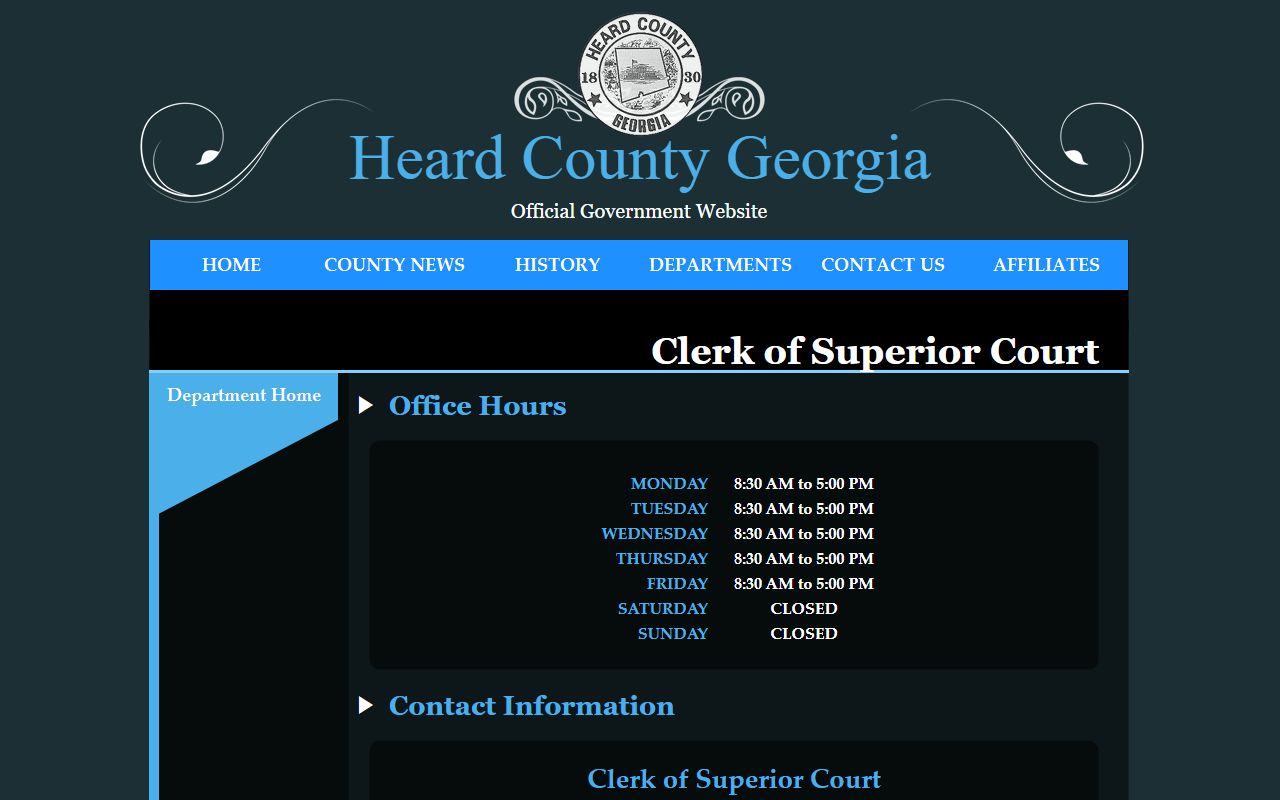
Use those clerk details when a Heard County Superior Court record needs a certified copy, a seal, or a staff check that a statewide portal cannot provide.
Heard County Clerk Record Duties
The Heard County Clerk of Superior Court is the local records contact for Superior Court filings. That includes civil pleadings, felony criminal filings, divorce case files, orders, judgments, docket entries, and certified copies for Superior Court cases. The office also appears in state clerk sources as managing Superior and Juvenile courts, but juvenile access is limited. A person looking for an adult felony disposition, divorce decree, civil judgment, or Superior Court docket copy should start with this office or the state e-access path that sends Heard Superior users toward PeachCourt.
Other Heard County courts maintain their own functions. Probate Court handles wills, estates, guardianship and conservatorship matters, marriage licenses, vital records, weapons carry applications, fireworks permits, and county traffic citations. Magistrate Court handles small civil claims, dispossessory cases, warrant functions, bond or preliminary matters, and local magistrate filings. The sheriff handles jail, booking, incident, and sex-offender material. Sorting the record by office first saves time because the Superior Court clerk cannot issue a Probate Court marriage license or confirm a jail booking status.
- Superior Court civil and felony case filings
- Divorce decrees and family case records filed in Superior Court
- Certified copies and clerk-sealed Superior Court documents
- Juvenile clerk routing where access is legally allowed
- Local contact for older files or records not exposed by a portal
The GSCCCA Heard County clerk directory is the state directory source that confirms the clerk, address, county code, courts managed, and legal organ for Heard County.
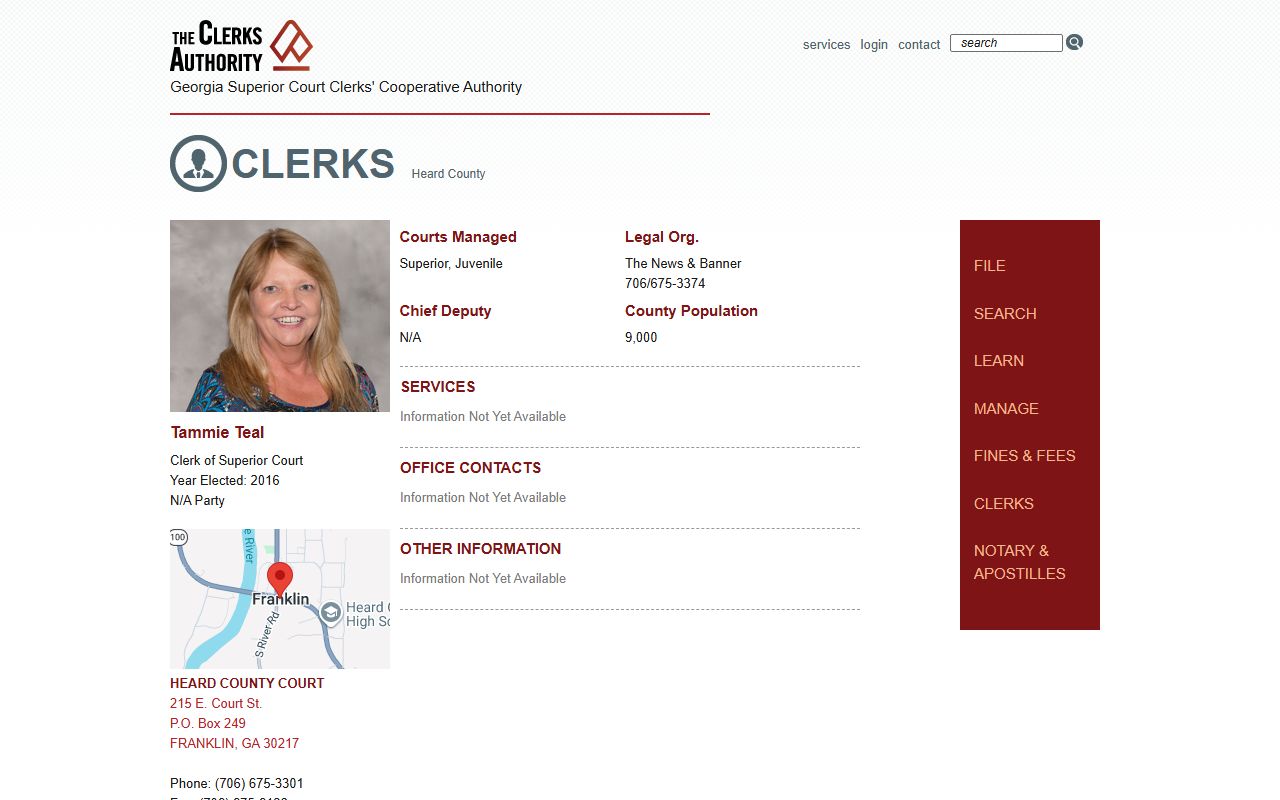
That statewide directory supports the same office routing used by the county page, so conflicting labels such as district clerk should not be used for Heard County.
Request Heard County Certified Copies
A certified copy is a copy marked by the clerk as a true copy from the court file. It is different from a screen print, a portal result, or an uncertified photocopy. Certified copies are often needed for divorce decrees, judgments, name-change documents, court orders, and legal proof for agencies outside the courthouse. Heard County's official Superior Court page does not publish a detailed copy-fee table, so a request should confirm the fee, the number of pages, and whether the copy needs certification or only a plain copy before payment is sent.
- Identify the case as a Superior Court case. Use the case number if known, or collect full party names, approximate filing year, case type, and the document needed.
- Contact the Clerk of Superior Court by phone, email, mail, or counter visit. Say whether a certified copy with seal is required.
- Ask staff to confirm the current copy cost, certification charge if any, accepted payment methods, and mailing options.
- Submit the request with enough detail for staff to locate the file. For mailed requests, include a return mailing address and any staff-required payment.
- Review the returned copy for the clerk seal or certification language before using it for court, agency, or title purposes.
Certified Superior Court copies should come from the Clerk of Superior Court, not from a general web search result or third-party background tool.
Heard County Request Fields
The countywide Heard County Open Records Request form is a fallback when the record is not published online or the correct office is unclear. Court files often begin with the clerk that maintains the case, while broad county records can route through the open-records form. The form does not replace the clerk's certification process, but it gives a formal path for records that can be disclosed under Georgia law.
| Field Label | Required | Notes |
|---|---|---|
| Date | Yes | Month, day, and year fields are shown. |
| Name | Yes | Requester name. |
| Address | Yes | Street, city, state or province, and postal code. |
| Phone Number | Yes | The form asks for a valid phone number. |
| Yes | Used for request communication. | |
| Request | Yes | Describe the record, office, names, dates, and case number if known. |
| Human verification | Yes | Anti-spam check before submission. |
For a Superior Court record, the request should name the court, party names, approximate date range, document type, and whether a certified copy is required. For a non-court record, state the office likely to hold it. Under Georgia's Open Records Act, access can still be limited by exemptions, redactions, court orders, juvenile confidentiality, active-investigation limits, or restricted personal information.
Heard County Clerk Fees
The inspected Heard County Clerk of Superior Court page did not publish a copy-cost schedule for Superior Court records. That gap matters because a certified divorce decree or a sealed copy can cost more than a plain copy. Confirm the amount with the clerk before mailing payment. The county open-records form also did not display a public fee schedule in the inspected form view, but Georgia law allows lawful search, retrieval, redaction, and copying charges in open-records matters.
| Item | Amount or Handling |
|---|---|
| Superior Court plain copies | Fee not located in the inspected Heard Superior Court page; contact the clerk. |
| Superior Court certified copies | Fee not located in the inspected Heard Superior Court page; contact the clerk. |
| Certification or seal | Confirm with the Clerk of Superior Court before payment. |
| General open-records request | Subject to lawful Georgia Open Records Act search and copy charges. |
| Marriage license without counseling | $76.00, handled by Probate Court rather than the Superior Court clerk. |
| Marriage license with counseling | $36.00, handled by Probate Court. |
| Extra certified marriage copies | $10.00 each, handled by Probate Court. |
Note: Marriage-license fees are included only to show the office split; those records are requested through Heard County Probate Court.
Heard County Clerk Search Channels
Heard County does not publish a single county-run all-cases search page for local court records. Superior Court users can begin with Georgia Courts E-Access, which lists Heard Superior through PeachCourt and warns that users are redirected to the provider website and must have an account to search court records. PeachCourt and Odyssey eFileGA are Georgia court e-filing and document systems, while the county clerk remains the local fallback for older files, certified copies, sealed-file questions, and records that the provider workflow does not expose.
The GSCCCA statewide search service is a different tool. It is useful for real estate, liens, plats, UCC, and related clerk filings, but it is not the same as a criminal or civil docket search. A felony case disposition should be routed through Superior Court records, while a deed or lien search can start with the state clerk search system.
- Georgia Courts E-Access for the Heard Superior provider path
- PeachCourt for Georgia court document and e-filing services
- Odyssey eFileGA for statewide e-filing workflows
- GSCCCA Search for real estate, lien, plat, UCC, and related clerk records
- Heard County Open Records Request for county records not published online
The GSCCCA search services page is the statewide clerk-record source for deeds, liens, plats, UCC records, and similar filings.
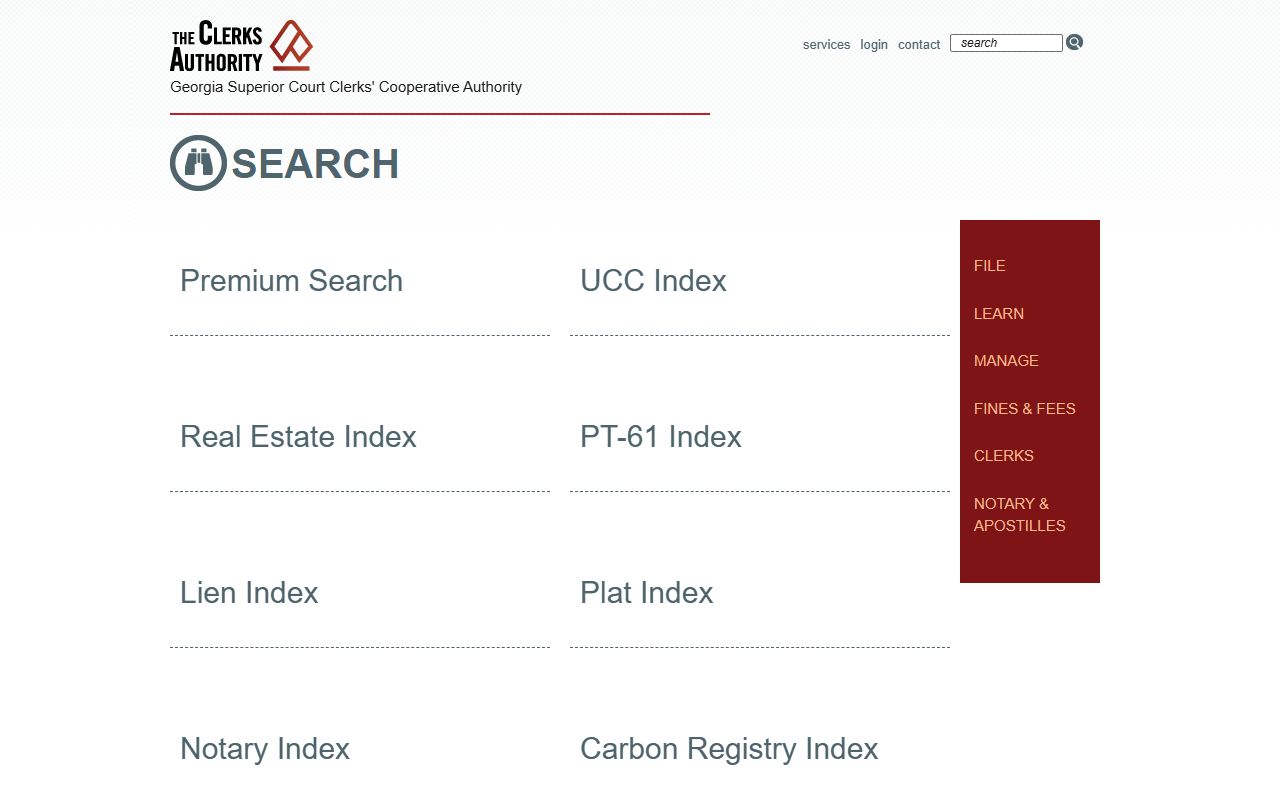
Use that system for clerk-indexed property and lien records, then use the Heard County Clerk of Superior Court or court e-access path for Superior Court case files.
Mail and Online Filings
Mail requests to the Clerk of Superior Court should use P.O. Box 249, Franklin, GA 30217. A clear mailed request should include the case number if known, party names, filing year, case type, specific document requested, copy type, requester contact information, and the return address. Because the fee schedule was not found in the official Heard Superior Court page, call before mailing money. For time-sensitive filings or documents that must be accepted by the court, confirm whether e-filing, counter filing, mail filing, or another method is required.
Online access is provider based rather than a county-hosted all-records portal. Georgia Courts E-Access points Heard Superior toward PeachCourt, while Georgia e-filing systems support court filing workflows. A provider account may help locate electronic documents, but account access does not remove court rules on sealed files, juvenile records, redactions, certified copies, or clerk-issued seals. When the record must be used as legal proof, the clerk's office should verify whether the online copy is enough or whether a certified copy is needed.