
Heard County Arrest Records and Court Charges
Arrest records and court charge records begin in different places. The arrest side is tied to law enforcement and booking. It may show the arresting agency, booking date, initial charge language, bond status, and custody details when those records are disclosable. The court charge side begins when a prosecutor files a complaint, accusation, information, or indictment, or when the court receives charge paperwork after a warrant or citation process.
Heard County does not publish an official online jail roster on the sheriff site. The sheriff pages provide jail contact information, visitation, mail, commissary, video visitation, bonds, and JailATM resources, but not a public current-inmate lookup. For current custody or booking confirmation, use the Heard County Jail or open-records request channels. For the full criminal case outcome after charges are filed, use the Heard County criminal court records case-file page.
The manifest image for the Heard County Magistrate Court page shows the lower-court venue tied to warrants, bonds, preliminary hearings, and local criminal process.
Magistrate Court can be part of the early path from arrest to court charge, even when a later felony file belongs in Superior Court.
Find Heard County Arrest Records and Charges
The practical search path starts with the type of information needed. For current custody, call Heard County Jail at the sheriff's office. For court charges filed after arrest, start with Superior Court or Magistrate Court depending on the matter. For felony prosecutions, the District Attorney files and prosecutes charges, but the filed court record is requested from the clerk that keeps the case.
- Check whether the need is custody confirmation, a booking record, a warrant, or the court charge filed after arrest.
- For custody or booking questions, contact Heard County Sheriff's Office or use the county open-records form for disclosable records.
- For formal court charges, identify the court: Superior Court for felony case files, Magistrate Court for warrant or preliminary matters, and Probate or Municipal Court for some traffic citations.
- Search Superior Court provider access through Georgia Courts E-Access when the case belongs to Superior Court.
- Request certified charge or disposition copies from the court clerk when the online provider does not supply official copies.
The sheriff channel is not the same as the court channel. The sheriff can confirm jail and booking records that are disclosable. The court clerk can confirm filed charges, hearings, pleas, dispositions, and sentence entries after a case opens.
Charging Documents After Arrest
Court charges after arrest become formal when a charging document is filed or returned. Georgia felony cases often involve an accusation or indictment, while lower-court matters can begin through warrant, citation, or complaint-style paperwork. A booking charge may be broad or preliminary. The filed court charge is the charge the court tracks through arraignment, motions, plea, dismissal, trial, or sentence.
| Document | Who Creates It | What It Does |
|---|---|---|
| Complaint or warrant paperwork | Officer, affiant, or court process | Starts or supports early criminal process, often tied to probable cause, arrest, bond, or preliminary hearing. |
| Accusation or information | Prosecutor | Formally charges an offense in court without a grand-jury indictment where Georgia procedure allows it. |
| Indictment | Grand jury | Returns felony charges for prosecution in Superior Court and creates formal count-by-count charge entries. |
The manifest image for the Heard County Juvenile Court page shows a separate route for minors.
Juvenile charge and custody records are restricted and should not be treated like adult arrest or court charge records.
Heard County Charge Status Terms
Charge status changes as prosecutors and courts act. A charge can be pending at arraignment, amended after review, reduced during plea talks, dismissed by the court, or nolle prossed by the prosecutor. One arrest can produce multiple charge counts, and each count may have a different result. The final status should be read from the court record, not only from the booking label.
| Status | What It Means |
|---|---|
| Pending | The charge remains open and has not reached a final disposition. |
| Amended | The filed charge changed, often in wording, count, statute, or severity. |
| Reduced | The charge moved to a lower offense level or lesser included offense. |
| Dismissed | The court ended the charge without conviction for that count. |
| Nolle prosequi | The prosecutor declined to continue prosecution on that charge, often shown as nolle prossed. |
| Disposed | The charge reached a recorded outcome such as plea, verdict, dismissal, or other closure. |
Charges vs Convictions in Heard County
An arrest or charge is not a conviction. A person may be arrested and never charged in court, charged and later dismissed, charged with one offense but convicted of another, or convicted only on some counts. Public users should read the disposition field before drawing conclusions from an arrest record or charge list.
| Charge | Conviction | |
|---|---|---|
| Record stage | Appears after arrest, citation, accusation, information, or indictment. | Appears after guilty plea, verdict, or court finding. |
| Meaning | Shows an allegation or filed count. | Shows guilt was legally established for that count. |
| Status changes | May be pending, amended, reduced, dismissed, or nolle prossed. | May lead to sentence, probation, fine, restitution, or later revocation. |
Sheriff and Prosecutor Charge Roles
The Heard County Sheriff's Office is the arrest and jail contact. The sheriff site names Sheriff Ross Henry and lists the office at 11820 HWY 100 N in Franklin, with jail staffing available 24 hours. The jail holds people arrested for felony and misdemeanor crimes and occasionally houses people for other jurisdictions. No official public roster was found, so custody confirmation should go through the jail phone or open-records channel.
The District Attorney prosecutes felony charges. Heard's local DA page still shows older Coweta Circuit wording, but state sources name Sarah Stimac Japour as District Attorney for the new West Georgia Judicial Circuit. The DA decides how felony charges proceed, yet the filed case record and certified copies remain with the court clerk after filing.
Heard County Sheriff's Office
11820 HWY 100 N
Franklin, GA 30217
(706) 675-3329
Jail staffed 24 hours; office hours 9:00 a.m.-5:00 p.m.
District Attorney's Office
215 E Court Square
Franklin, GA 30217
P.O. Box 730, Franklin, GA 30217
(706) 675-0955
Monday-Friday, 8:00 a.m.-5:00 p.m.; closed noon-1:00 p.m.
The manifest image for the Heard County Sheriff's Office homepage shows the law-enforcement side of arrest records.

The sheriff record can confirm booking or custody facts, while the court record confirms filed charges and outcomes.
Statewide Charge and Registry Checks
Statewide systems serve different purposes from local arrest records. The Georgia Department of Corrections Find an Offender search is for sentenced state prisoners, not a fresh Heard County jail booking. The GBI criminal-history restriction source explains how some records may be limited from public non-criminal-justice access. The GBI sex offender registry and sheriff sex-offender registration page relate to registration status, not a general arrest database.
Charge research can also cross paths with bonds and court dates. Heard Magistrate Court may be involved in warrant, bond, and preliminary-hearing issues, while the jail confirms custody and release details that are still held by the Sheriff's Office. If a person was arrested and released, the court charge may not be easy to find until the prosecutor files formal paperwork. If a person missed a court date, a bench warrant or failure-to-appear entry may appear through the issuing court rather than through a booking search.
For a practical request, collect the name used at booking, date of birth if available, arrest date, arresting agency, citation or warrant number, and any court date or bond paper. Those details help the sheriff, Magistrate Court, District Attorney, or Clerk of Superior Court distinguish one person from another and locate the right charge record.
The manifest image for the Heard County sheriff sex-offender registration page shows one specialized public-safety record connected to criminal history.
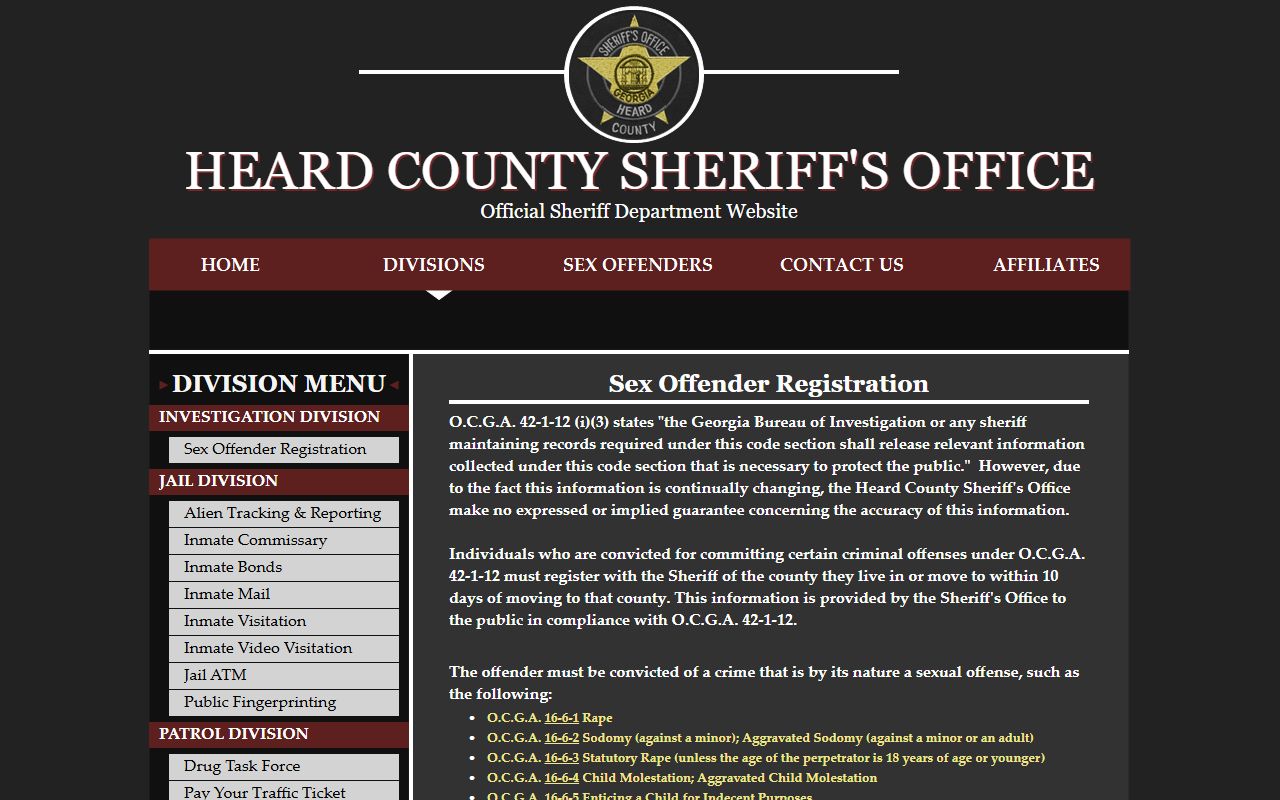
Registration records should not be confused with a full criminal court file or a county arrest booking record.
Restricted Heard County Charge Records
Some arrest and charge records are not fully public. Juvenile cases are restricted. Sealed court files, active investigations, protected addresses, medical details, Social Security numbers, and minor names may be withheld or redacted. O.C.G.A. 35-3-37 controls Georgia criminal-history record restriction in qualifying situations. Georgia's Open Records Act supports access to public records, but O.C.G.A. 50-18-72 allows exemptions for confidential, investigative, security, juvenile, medical, and personal information.
For public-record requests, describe the exact charge record sought instead of asking for a broad background check. A useful request names the defendant, date of arrest, arresting agency if known, court date, warrant or citation number, and whether the requester needs booking information, the filed charging document, a disposition, or a certified court copy. That distinction helps the Sheriff's Office, Magistrate Court, District Attorney, and Clerk of Superior Court route the request without mixing booking facts with court-file outcomes.
| Record issue | Practical effect |
|---|---|
| Juvenile charge | Access normally requires party status, attorney role, agency authority, or a court order. |
| Active investigation | Law enforcement may withhold or redact safety-sensitive or investigative material. |
| Dismissed or eligible record | Georgia record restriction may limit non-criminal-justice access if statutory criteria are met. |
| Personal identifiers | Social Security numbers, financial data, dates of birth in some contexts, and protected addresses may be redacted. |
Note: A booking charge is not the final court result; always check the filed case disposition.